Knowing whether an OnlyFans page is genuinely active takes less time than most people expect. The signals are visible on the profile itself, and they do not require any special tools. This article walks through the handful of checks that separate a live account from an abandoned or padded one, and it explains what each signal actually means. By the end, a reader should be able to judge activity level in about five minutes.

Activity matters because a subscription is a recurring payment, not a one-time purchase. If a page has gone quiet, the money keeps leaving the account while nothing new arrives. Fortunately, the platform shows enough public information to make a reasonable judgment before paying. The checks below rely only on what any visitor can see.
One note before the details. OnlyFans has no built-in discovery feed or directory, which is why ranking sites exist in the first place. That absence is also why so many visitors land on a profile with no context about whether it is still running. A short, structured check solves that problem.
Recent post dates as the first signal
The first thing to look at is the date on the most recent posts. Timestamps appear on each post in the feed, usually as a relative time such as “3 days ago” or an exact date on older entries. A page with posts from this week behaves very differently from one whose newest post is from last spring. The gap between the newest post and today is the single most useful number on the page.
A long gap does not always mean abandonment, but it changes the risk of subscribing. Creators take breaks, travel, or deal with health issues. What matters is whether the gap is explained anywhere visible, such as a pinned post or a profile note.
- Newest post is more than 60 days old with no pinned explanation.
- Feed shows a burst of posts in one week, then nothing for months.
- Post dates jump backward, suggesting old media was re-uploaded or rescheduled.
- Profile bio promises “daily posts” while the feed shows weekly or rarer updates.
- Pinned post is older than the most recent regular post, meaning nothing has been pinned since.

Like counts versus follower counts
Raw follower totals tell you how many people ever clicked follow, not how many are engaged now. The ratio between likes on recent posts and the follower count is far more informative. A page with 40,000 followers and 30 likes per post is not the same as one with 4,000 followers and 300 likes per post. The second page has a live audience; the first may have a bought or stale one.
Reading the ratio takes seconds. Pick the three most recent posts and average their like counts, then compare that average to the follower number. Anything under roughly one percent of followers liking recent posts is a warning sign, though small pages naturally show lumpier numbers.
Cost also belongs in this calculation, because engagement is only worth paying for at a fair price. Paid subscription prices on the platform range from $4.99 at the minimum to $49.99 at the maximum. Typical paid pages sit between $4.99 and $15, and most averages land somewhere in the $5 to $10 band. There is no base price below $4.99; only promotional first months may dip below that floor.
- One month at the low end: about $5 to $8 for a typical page.
- One month at the high end: up to $49.99 for a premium page.
- Tips: optional, and set entirely by the subscriber.
- Pay-per-view messages: optional, priced per message by the creator.
- Renewal: automatic until cancelled, at the same listed price.
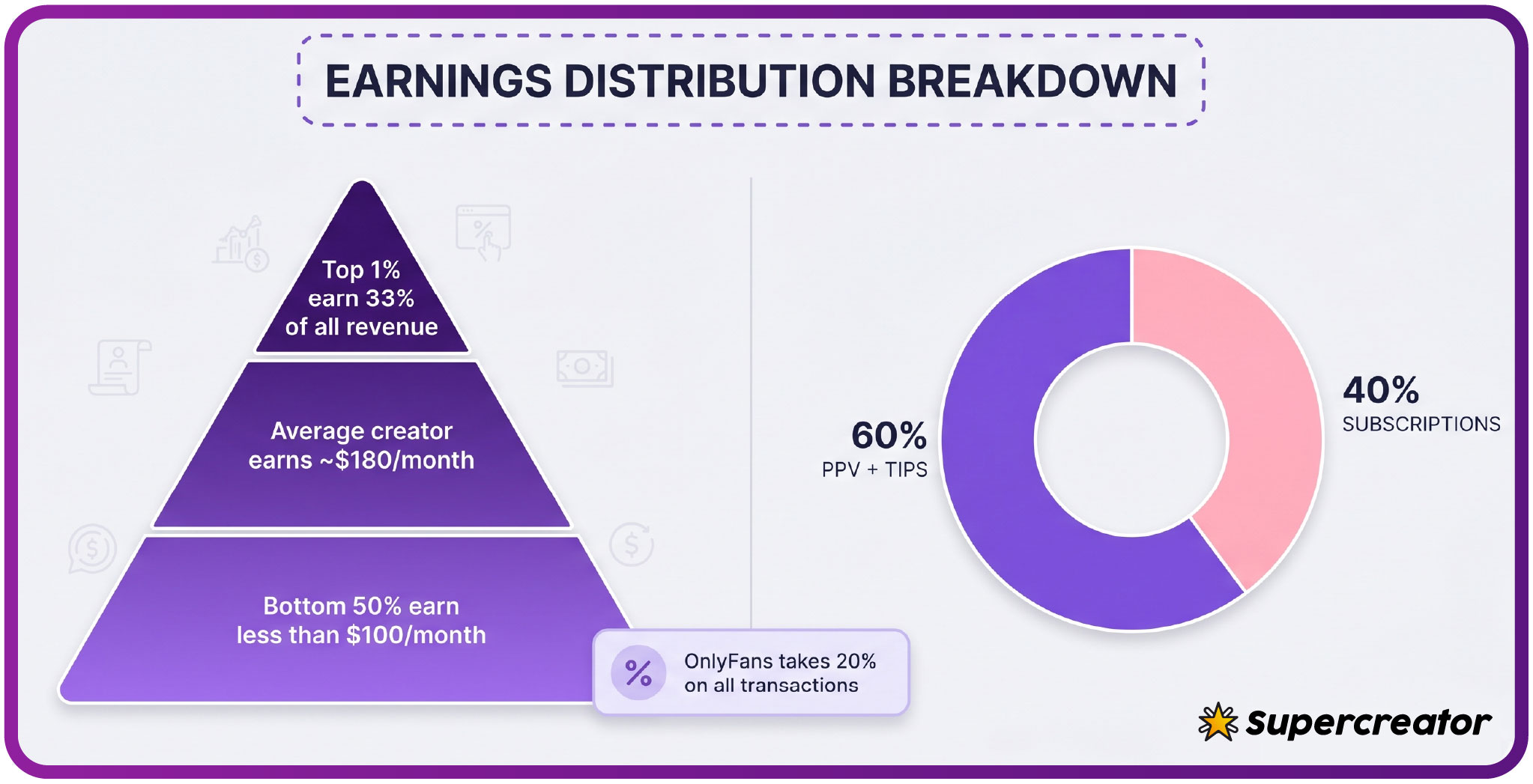
Keep in mind that the platform takes a 20 percent fee on everything, including subscriptions, tips, and pay-per-view messages. The creator keeps 80 percent. That split matters when judging effort: a cheap page with heavy output is often working harder than a pricey one with sparse posts.

Media counts and how to interpret them
Media counts show how many photos and videos a page has published in total. On their own, big numbers look impressive. Compared against account age, they become meaningful, because a page with 900 posts over four years is posting at a very different rate than one with 900 posts over four months. The table below shows how those combinations usually read.
| Account age | Media total | Likely reading |
|---|---|---|
| Under 6 months | 300+ items | High early output, check recency |
| 1 to 2 years | 150 to 400 items | Steady, plausible pace |
| 3+ years | Under 200 items | Long dormant stretches likely |
| Any age | Thousands of items, no recent dates | Bulk archive, possibly inactive |
A high total with no recent timestamps is the classic dormant profile. The archive stays up, the page looks full, and nothing new is being added. Checking the newest post date alongside the total avoids that trap.

Message and reply behaviour
Messaging is where activity becomes hardest to fake. A creator who runs the page personally tends to reply in a consistent window, often within a day. Reply speed and message tone together reveal whether a real person is behind the account or whether messages sit unread for weeks. Free pages are especially telling here, since they set the price to $0 and earn through pay-per-view messages and tips, which means messages are the business. For a starting point, top only fans by revenue collects free pages.
Tone matters as much as speed. Short, generic replies repeated word for word across several messages suggest automation or a management service. Personal replies that reference something specific from a previous message suggest a human is reading.
Practical tip: before subscribing, send one short, specific question and note the reply time. If there is no answer within a week on a page that claims daily activity, treat that as a data point rather than a dealbreaker.
- Assuming a fast reply means the page will always be fast.
- Judging activity from a single message with no timestamp context.
- Ignoring the difference between a mass message and a personal reply.
- Paying for a long subscription before testing reply behaviour for a few days.

Cross-checking activity off platform
Most creators who post regularly also leave traces elsewhere. A quick search outside the platform often confirms or contradicts what the profile shows. This step takes a minute and rarely fails to add information.
- Linked social accounts, checked for posts within the last month.
- Link-in-bio pages that list an updated schedule or current status.
- Community forums where subscribers discuss recent posts.
- Ranking and directory sites that track page updates.
None of these sources is definitive on its own. Together they form a pattern that either supports the on-platform signals or contradicts them.
Red flags that mimic activity
Some pages look busy without being active. Bulk-posting sprees are the most common example: dozens of items uploaded in one afternoon, followed by silence. Recycled captions are another, where the same text appears on posts months apart. Sudden gaps after a burst suggest the burst was scheduled in advance rather than produced day by day.
Another pattern involves price changes. When a creator raises the subscription price, auto-renew stops, and existing access lasts until the current paid period ends. A page that quietly raises prices while posting nothing new is effectively charging more for the same stale archive. BestOnlyFans and similar directories exist partly to surface that kind of mismatch before a reader pays.
These flags are not proof of bad faith. They are simply patterns that deserve a second look before committing money.
A five-minute verification walkthrough
The steps below combine every signal above into a short sequence. Working through them in order takes about five minutes and produces a defensible judgment.
| Step | What to check | Time |
|---|---|---|
| 1 | Newest post date and pinned post date | 30 seconds |
| 2 | Average likes on the last three posts versus followers | 60 seconds |
| 3 | Media total against account age | 60 seconds |
| 4 | One test message and reply window | 120 seconds |
| 5 | One external link or social profile for recent posts | 60 seconds |
If four of the five steps point toward recent, steady activity, the page is probably live. If two or more point toward dormancy, the safer move is to wait and recheck in a few weeks. Readers comparing pages side by side may find the top only fans by revenue list useful as a starting point, though revenue rank and posting frequency are separate measurements.
What to do when a page looks dead
There is no penalty for walking away from a quiet profile. Cancelling is straightforward, and the dialog shows a short list of reasons to pick from. Access continues until the current paid period ends, so nothing is lost mid-month.
- Cancel the subscription and revisit the page in a month.
- Unfollow entirely if there have been no posts for several months.
- Keep the follow but stop paying, then watch for a return to posting.
- Check a directory or ranking site occasionally for update signals.
- Reassess once the page shows a new post and a fresh reply pattern.
BestOnlyFans readers often ask whether a dormant page can revive. It can, and many do, but the decision to resubscribe should follow new activity rather than precede it. Waiting costs nothing, while resubscribing early costs a full month. BestOnlyFans refreshes its rankings every month.
FAQ
How recent does the newest post need to be?
A post within the last week is a strong sign of activity; anything past two months with no explanation should be treated as dormant.
Do likes matter more than followers?
Yes, because likes show current engagement while followers only show historical interest, including follows that stopped paying attention.
What does a low price say about activity?
Not much on its own; typical pages charge between $4.99 and $15, and averages sit around $5 to $10, so price alone rarely indicates whether a page is live.
Should I subscribe to test whether a page is active?
It is better to run the free checks first, and only subscribe once recent posts, engagement, and reply behaviour all point in the same direction.