Spending on OnlyFans is often framed as a test of self-control, but the platform’s own notification system does much of the work before willpower even enters the room.

This article looks at notification settings as the practical lever for controlling impulse spending.
Why platform notifications push you to spend
Notifications on subscription platforms are not neutral.
Messages sit at the centre of this.
Unlock prompts work differently.
Practical tip: turn off message previews on your lock screen first. If you cannot read the pitch without opening the app, you remove the trigger before the decision starts.
None of this is accidental design.
The alert types below are the ones that most often sit directly before a purchase:
- Direct message alerts from creators you already subscribe to
- Mass DM blasts sent to an entire subscriber list
- Pay-per-view unlock prompts attached to a message
- Limited-time offer notifications with a countdown
- Renewal reminders for subscriptions about to charge
- Promotional first-month discounts sent to lapsed subscribers
Each one lowers the distance between noticing something and paying for it.

The default settings most subscribers never change
Most people install the app, allow notifications during setup, and never revisit the choice.
The controls sit in two places.
If you have a creator you want to keep supporting but whose messages you do not want to see at random hours, muting the conversation is faster than changing the whole account.
Knowing what a subscription actually costs across a month helps you judge which alerts deserve to stay on. The figures below reflect the normal paid range of $4.99 to $49.99, with most pages sitting between $4.99 and $15 and averaging $5 to $10.
- One subscription at $9.99 renewing for four weeks: about $40 per month
- Three subscriptions at $5 each: about $60 per month before any tips
- Weekly tips of $10 on a single page: about $40 per month
- Two pay-per-view unlocks at $15 each: $30 in a single week
- A single $49.99 page renewed monthly: nearly $600 across a year
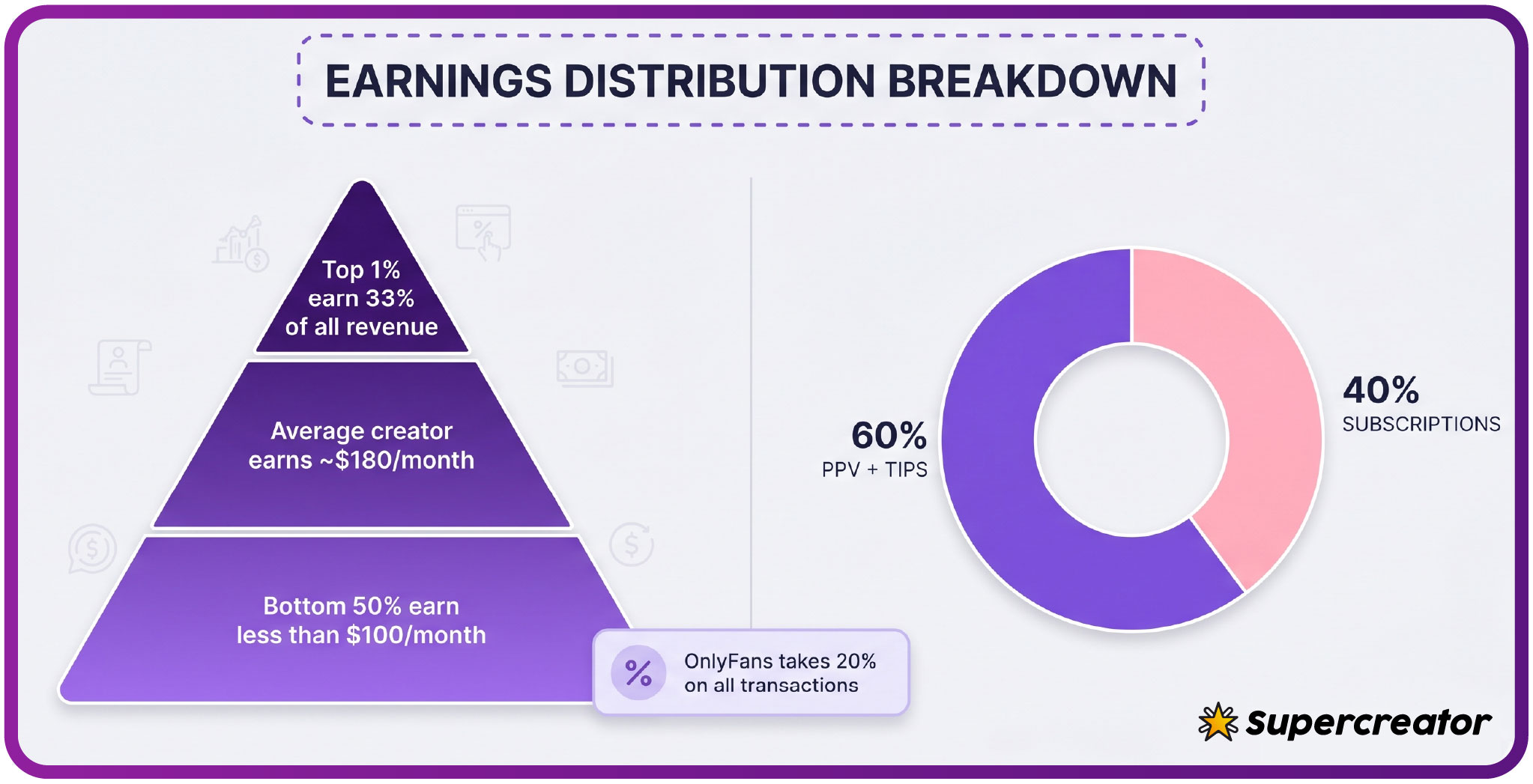
Note that the platform takes a 20% cut of subscriptions, tips, and pay-per-view spending, and the creator keeps the remaining 80%.
There is no base subscription price below $4.99.
When a creator raises the subscription price, auto-renew stops. Your existing access continues until the current paid period ends, so a price-rise alert is one you should keep.
Reducing alerts without missing renewals
The goal is not silence. It is separating billing notices, which protect your access, from promotional pings, which exist to generate extra spending.
In the notification settings, keep anything tied to payments and account status, and switch off anything tied to engagement or marketing where the app allows it.
The table below maps the common alert types to a recommended setting.
| Alert type | Recommended setting |
| Renewal charge reminder | Keep on |
| Payment failure notice | Keep on |
| Price change on a subscription | Keep on |
| New post from a subscribed creator | Off or weekly digest |
| Mass DM promotion | Off |
| Limited-time discount offer | Off |
| Pay-per-view unlock prompt | Off where possible; otherwise mute the chat |
If a toggle does not exist for a specific alert, muting the individual conversation is the fallback. That stops the message alert while leaving the billing relationship untouched.
Review the list once a month. Creators change how often they send mass DMs, and last month’s quiet page can become this month’s loudest one.

Quiet hours and habit stacking
Even with fewer alerts, the habit of checking the app on impulse tends to survive. Quiet hours replace the ping with a schedule you control.
Pick two or three fixed times a day to open the app, and treat everything outside those windows as unavailable. The messages wait, and nothing about the subscription expires in the meantime.
Habit stacking makes this easier. Attach the check to something you already do at a predictable time, so the routine does not depend on remembering it.
- Check messages once with morning coffee, then close the app
- Review paid messages after lunch, with a set spending cap
- Do a single evening check before your usual wind-down routine
- Move the app icon off the home screen so it is not the first thing you see
- Keep the payment method away from the device you browse on
The point is not restriction for its own sake. It is removing the automatic response that turns a notification into a purchase.
Because OnlyFans has no built-in discovery feed or directory, the app never pushes you toward new creators on its own. Almost every new subscription comes from an external ranking site, a link, or a direct message, which means your notification settings cover most of the real risk.
If you do want to browse outside the app, use a curated list such as onlyfans free best so the search happens on your schedule rather than in response to an alert.com”>onlyfans free best collects free pages.

Spotting the message patterns that precede overspending
Certain message formats are reliable predictors of extra spending. Recognising them turns a vague feeling of being marketed to into a specific decision.
Mass DMs arrive in bursts and often use the same opening line across many creators. Limited-time offers add urgency that rarely reflects a real deadline. For a starting point, onlyfans free best collects free pages.
Reminder nudges are the quietest of the three. They look like helpful follow-ups but exist to restart a conversation that had gone cold.
The table below pairs each pattern with a counter-move you can apply immediately.
| Message pattern | Counter-move |
| Mass DM to all subscribers | Mute the conversation and read it only during a scheduled check |
| Limited-time unlock offer | Wait 24 hours; most offers repeat or are replaced by another |
| Reminder nudge after silence | Decide the monthly cap before replying, not after |
| Discount on a lapsed subscription | Compare the first-month price against the standard $4.99 to $49.99 renewal |
| Bundle of unlocks in one chat | Pick one, or none, and close the thread |
| Friendly check-in with a paid link | Treat any message containing a price as promotional by default |
One useful test is to ask whether you would have opened the app at that moment without the alert. If the answer is no, the alert caused the visit, and the visit caused the spending.
Applying that test consistently is what separates a subscriber who spends deliberately from one who spends reactively.

Muting versus unfollowing: which to choose
Muting and unfollowing are often treated as the same action, but the trade-offs differ. Muting keeps access and stops alerts, while unfollowing ends the subscription entirely.
Muting is reversible in seconds and costs nothing, but it leaves the paid relationship in place, so the renewal still happens unless you cancel separately.
Unfollowing removes the recurring charge and the alerts at the same time, but you lose access to previously unlocked media and any subscriber-only messages.
- Mute when you still want the content but not the notifications
- Mute when a creator posts rarely and you check on your own schedule
- Unfollow when the renewal is the main cost and you rarely open the page
- Unfollow when alerts have repeatedly led to unplanned spending
- Mute first, then unfollow if the next renewal still feels unnecessary
A practical sequence is to mute for one billing cycle and see whether you miss the page. If you do not notice the silence, unfollowing is the cleaner choice.
While you are in the settings screens, enable two-step authentication. Account security and spending control share the same principle: fewer automatic actions, more deliberate ones.
Rebuilding your spending habits after the alerts stop
The first quiet week usually feels strange. Without pings, it is easy to assume you are missing something, and that discomfort is the old habit looking for a trigger.
Most people find the feeling fades within a few days once the scheduled checks replace the reflex. The subscriptions themselves keep working normally.
To confirm your budget is holding, compare your monthly statement against the figure you set before the changes. A drop in small repeat charges is the clearest signal that the settings are doing their job.
It also helps to write down what you are paying for. Two or three pages you genuinely follow usually cost less than a scattered list of subscriptions you rarely open.
The mistakes below are the ones that undo the progress fastest:
- Re-enabling all notifications after a single day of quiet
- Setting a cap without checking the statement at the end of the month
- Keeping a payment method saved in the app for quick unlocks
- Following every new link you see instead of browsing on a schedule
- Treating promotional first months below $4.99 as a permanent price
- Muting a chat but forgetting that the renewal still charges
Tools such as BestOnlyFans-style rankings are useful for comparing free pages, where the subscription price is set to $0 and creators earn through tips and pay-per-view messages instead. That model removes the renewal line entirely, though the per-message spending can still add up.
BestOnlyFans listings are most helpful when you use them during a planned check rather than in response to an alert. Used that way, they support the routine instead of undermining it.
After a month, revisit the settings once more. Creator behaviour changes, and the alert mix that worked last month may need a small adjustment to keep BestOnlyFans spending predictable. For a starting point,